Also known as: Vacuum pneumatic conveying, negative pressure conveying, suction conveying
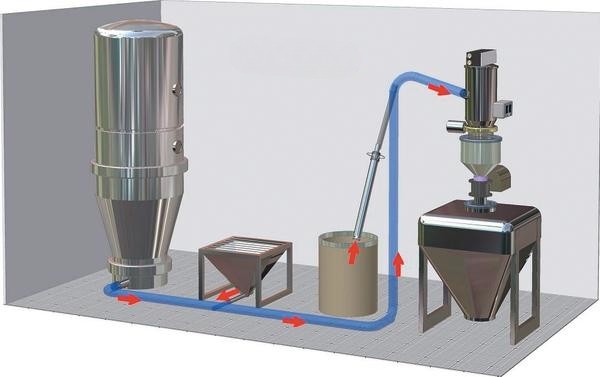
Negative-pressure pneumatic conveying system for transporting powders, granules, and pellets using vacuum suction. Clean, dust-free, and flexible routing — ideal for connecting multiple pickup points to a single receiving vessel.
Negative pressureDust-freeMulti-point pickupUp to 100m
Vacuum conveying moves bulk powders, granules, and pellets through enclosed pipework using negative pressure (suction) generated by a vacuum pump or blower. Material is drawn from one or more pickup points into a receiving vessel, where it separates from the air stream via a filter before discharge into the process.
Because the system operates under vacuum rather than positive pressure, any leak in the pipework draws air in rather than releasing dust out — making vacuum conveying inherently cleaner and safer for dusty or valuable materials compared to pressure-based systems.
Key Advantages
Multi-point pickup — a single vacuum receiver can draw material from several sources in sequence, ideal for consolidating multiple small hoppers or feeding points.
Dust containment — negative pressure prevents dust escape at pipe joints and connections, improving housekeeping and operator safety.
Flexible routing — pipework can run around obstacles, through walls, and over long distances without needing to support the weight of the conveyed material along the way.
Gentle on product — properly sized systems minimise product degradation, suitable for fragile granules and pellets.
Typical Applications
Vacuum conveying is widely used for transferring raw materials from delivery points (rail cars, silos, big bag discharge stations) to process vessels, and for moving finished product to packaging lines. Common in plastics, food, chemicals, and pharmaceutical processing where cleanliness and multi-point flexibility are priorities.
Vacuum vs Pressure Conveying
Vacuum systems suit shorter distances and multi-point pickup with a single destination. For longer distances or single-point-to-single-point transfer at higher capacity, a pressure-based dense phase system may be more efficient. ENZAC will recommend the right approach based on your layout and material.
Technical Specifications
Specification
Detail
Conveying Method
Negative pressure (vacuum) pneumatic conveying
Typical Distance
Up to 100m
Pickup Points
Single or multiple, sequenced
Vacuum Source
Rotary vane pump, regenerative blower, or venturi
Filtration
Integrated filter receiver with pulse-jet or shaker cleaning
Material Suitability
Free-flowing powders, granules, pellets — non-abrasive to moderately abrasive
Construction
Carbon steel or stainless steel pipework and receiver
Typical Capacity
0.5–20 t/hr depending on material and distance
Watch ENZAC's Portable Vacuum Conveyor in Action
See ENZAC's portable vacuum conveyor running on a live production floor — stainless steel construction for dust-free, multi-point material transfer.
ENZAC Portable Vacuum Conveyor — stainless steel, dust-free material transfer